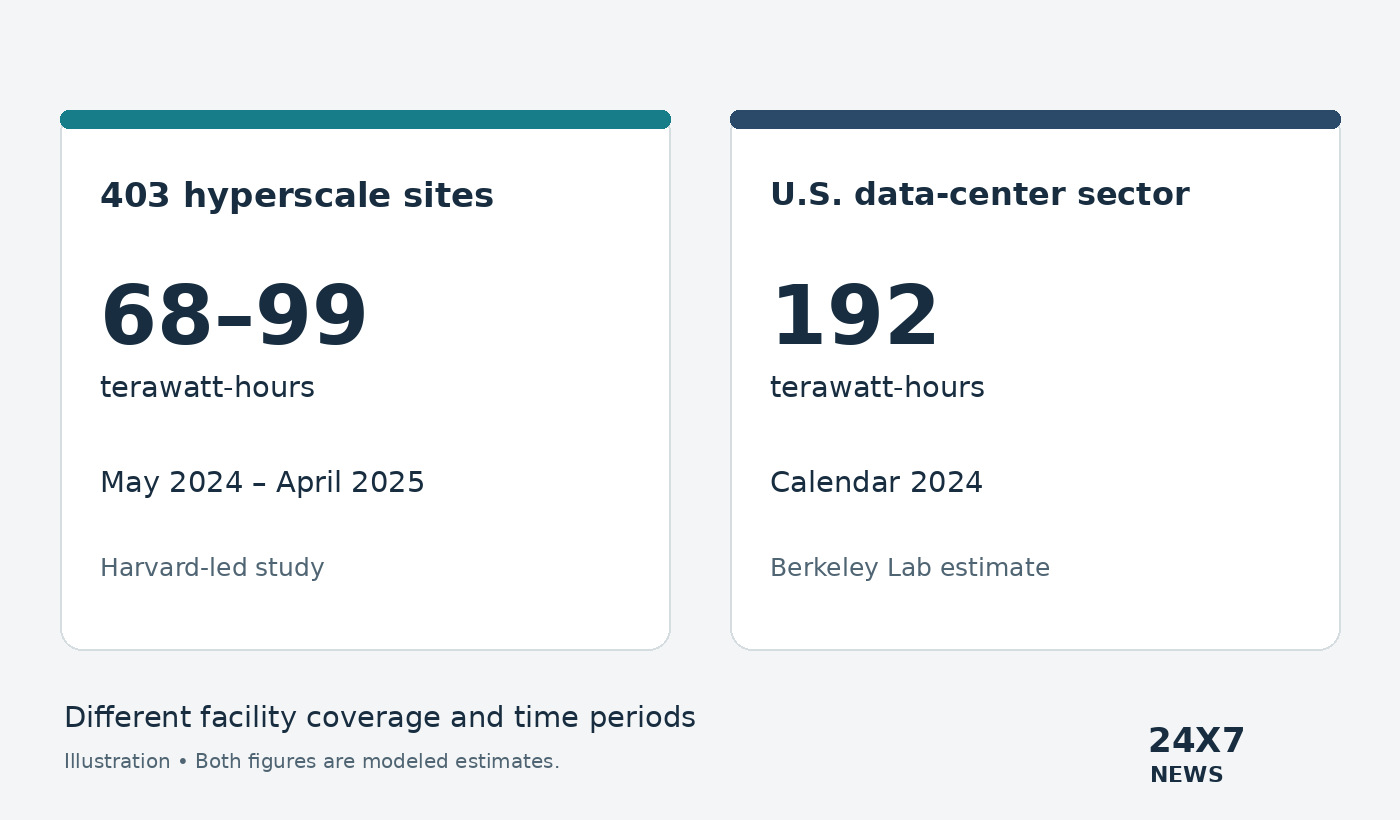
A Harvard-led study published November 16 in Nature Sustainability estimates that 403 U.S. hyperscale data centers used 68–99 terawatt-hours of electricity between May 2024 and April 2025, depending on operating assumptions. The range describes a selected group of large facilities during that period.
It answers a different question from the national total in Lawrence Berkeley National Laboratory’s latest data-center energy report. That report, released in June 2026, estimates 192 terawatt-hours across U.S. data centers in calendar 2024, or 4.7% of national electricity consumption. Its accounting includes servers, storage, networking and supporting infrastructure, while excluding cryptocurrency mining.
The figures cannot establish that industry electricity demand fell: their facility coverage, time periods and methods differ. Adding them together would also mix overlapping populations.
According to Harvard’s release, the new researchers assembled a facility list using satellite imagery and estimated consumption under different operating scenarios. They assigned emissions using the electricity-generation mix of regional grids.
The study could not cover every hyperscale facility or separate AI-specific electricity use from general computing. Its operating window ended in April 2025, so the estimates do not measure current November 2026 consumption.
Berkeley Lab uses equipment-shipment data, estimates of installed hardware, device power demand and cooling performance to model the wider industry. It separately projects 649 terawatt-hours in 2030 in its reference case, with combined uncertainty scenarios spanning 521–843. Those are forecasts, distinct from its historical 2024 estimate.
Sources
- Harvard T.H. Chan School of Public Health — November 16 study release: https://hsph.harvard.edu/news/hyperscale-data-centers-energy-consumption-carbon-emissions-newly-estimated-by-researchers/
- Lawrence Berkeley National Laboratory — United States Data Center Energy Usage Report: 2025 Update, June 18, 2026, executive summary and printed pages 8–9, 12: https://www.energy.gov/documents/united-states-data-center-energy-usage-report-2025-update