Hydrogen chloride detected above fissures near a vast Martian volcano may be evidence that Mars still has volcanic activity below its surface, according to research published Wednesday, November 4.
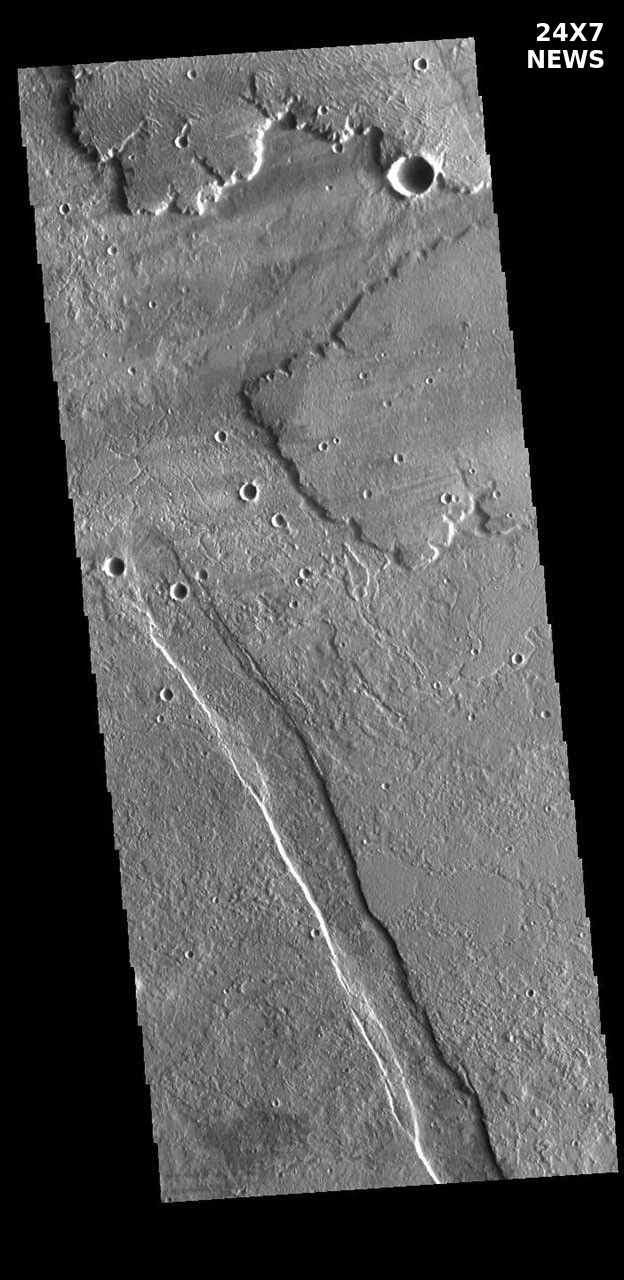
The ExoMars Trace Gas Orbiter recorded pulses of the gas in the lower atmosphere above fissures on the northern flank of Alba Mons. The shield volcano is the largest on Mars by surface area.
Researchers traced the unusual detections to a location and season that did not fit the broader hydrogen-chloride cycle previously observed on the planet. Their paper in Science Advances identifies volcanic seepage as the most likely explanation after considering other atmospheric and surface-chemistry processes.
On Earth, hydrogen chloride can be released when chlorine-bearing compounds dissolved in magma escape as the magma rises and pressure falls. The Martian gas could be moving through surface fractures connected to a dormant underground magma chamber, the researchers said.
The team proposed a seasonal mechanism for the pulses. Gas rising from below may be blocked by winter ice, then released when that ice changes directly into vapor during the Martian summer. Orbital images also show narrow fissures and possible deposits around vents in the Alba Mons region.
The finding does not document an eruption or lava flow. It is atmospheric evidence consistent with ongoing magmatic processes, and researchers said additional observations are needed to establish the source and activity below the surface.
If confirmed, the result would mean Mars retains enough internal heat for volcanic processes despite its relatively dormant appearance. It could also guide future searches for habitable environments. Magma interacting with underground water can create hydrothermal systems that provide heat, chemical energy and protection from harsh surface conditions.
The Trace Gas Orbiter reached Mars in 2016 as part of the European Space Agency-led ExoMars program. Its instruments are designed to measure small amounts of atmospheric gases that may reveal active geological or biological processes.
Sources: - Reuters, November 4, 2026 - Space.com, November 4, 2026 - Space Research Institute of the Russian Academy of Sciences, November 4, 2026